The International Food Policy Research Institute (IFPRI), in collaboration with the Ministry of Agriculture and Animal Resources (MINAGRI) held a workshop on May 20th to discuss better integrating the effects of climate change and climate smart agriculture into the Rwandan Economy. Working closely with participants from several government agencies, interested donors, and researchers, the objective of this workshop was to provide an overview of IFPRI’s Rural Investment and Policy Analysis (RIAPA) modeling and its current use as a tool for policy design and impact analysis in Rwanda and how it could be expanded into areas of interest including climate change impacts and climate mitigation strategies.
Designing effective agricultural policies requires more than experience and intuition, it demands analytical tools capable of capturing complex trade-offs, assessing the impact of public investments, and grounding decisions in evidence. Agricultural economic modelling has emerged as one of the most powerful instruments for this purpose. It was with this conviction that this workshop was convened to examine how economic modelling is being applied in Rwanda's agricultural policy design and impact analysis, and how these tools can be strengthened for the challenges ahead.
The workshop was officially opened by the Permanent Secretary of the Ministry of Agriculture, Dr. Olivier Kamana, who underscored both the importance of these analytical tools and the need for national ownership of the insights they generate. He summarized that Rwanda's bold vision for agricultural transformation — from food security to climate resilience — demands that every investment decision deliver maximum impact for our farmers and our economy and that is why rigorous analytical tools like RIAPA are essential: they turn Rwanda's ambitions into evidence-based action.
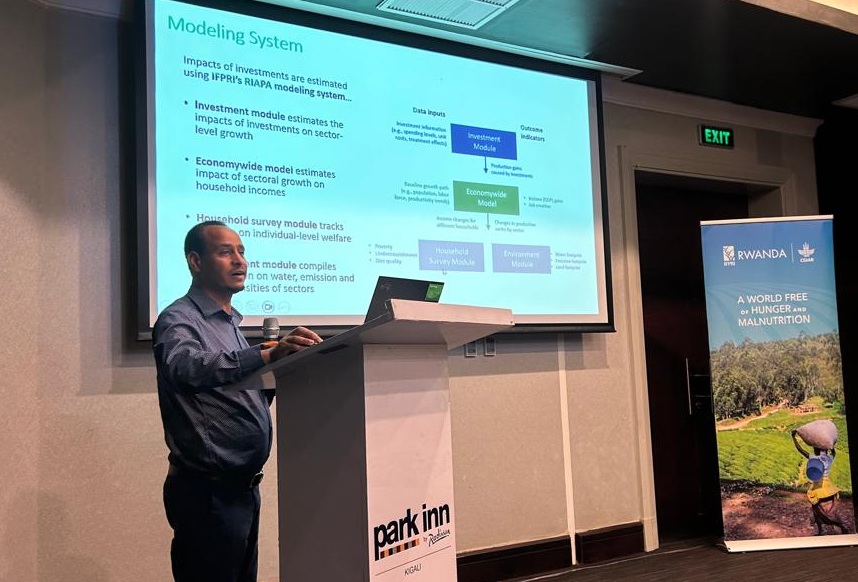
Dr. Emerta Aragie, a Research Fellow in IFPRI's Foresight and Policy Modelling Unit, introduced the RIAPA model and its application in estimating the impacts of investments outlined in Rwanda's fifth Strategic Plan for the Transformation of Agriculture (PSTA 5), examining their economic, social, and environmental outcomes. He explained how the model integrates four core components: an investment module, an economywide model, a household survey module, and an environment module. Key findings highlighted that investments in SME processors and livestock extension services are most effective at stimulating agrifood system growth and employment, while farmer credits and improved seed systems have a stronger influence on social outcomes. Food loss reduction and agronomic advisory services also proved cost-effective in accelerating rural transformation.
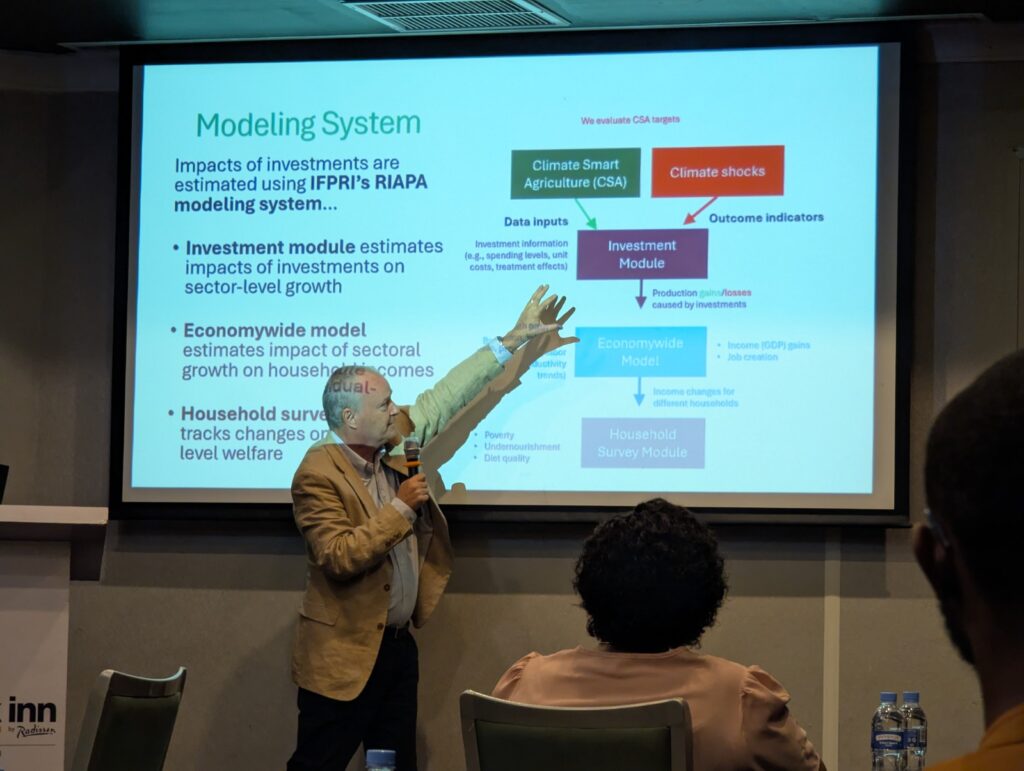
Dr. James Warner, RSSP Program Leader, built on this foundation with a presentation on how RIAPA can be used to assess the economic impacts of climate shocks and evaluate the contribution of climate-smart agriculture (CSA) interventions. He stressed the importance of examining cost-effectiveness, understanding trade-offs across different outcomes, and measuring impacts across the full agrifood system and population. Modelling the economy's trajectory under PSTA 5 interventions alongside climate shocks and CSA responses, a key takeaway was that while CSA interventions contribute positively to the economy, they do not fully offset the annual expected losses arising from historical climate shocks.
Mr. Josue Niyonsingiza's presentation emphasized the household-level effects of CSA interventions and climate risks, exploring who gains and who loses under different scenarios. He demonstrated that disaggregating results by household group reveals dynamics obscured by national-level figures, for instance, that poor households gain twice as much as non-poor households from CSA interventions, yet also suffer greater losses under climate shocks. Examining consumption spending, poverty, and malnutrition, Mr. Niyonsingiza showed that while CSA interventions broadly offset climate stress, the benefits are uneven: consumption spending is largely restored for most households, but poverty and undernourishment reductions are weaker for the rural and urban poor.
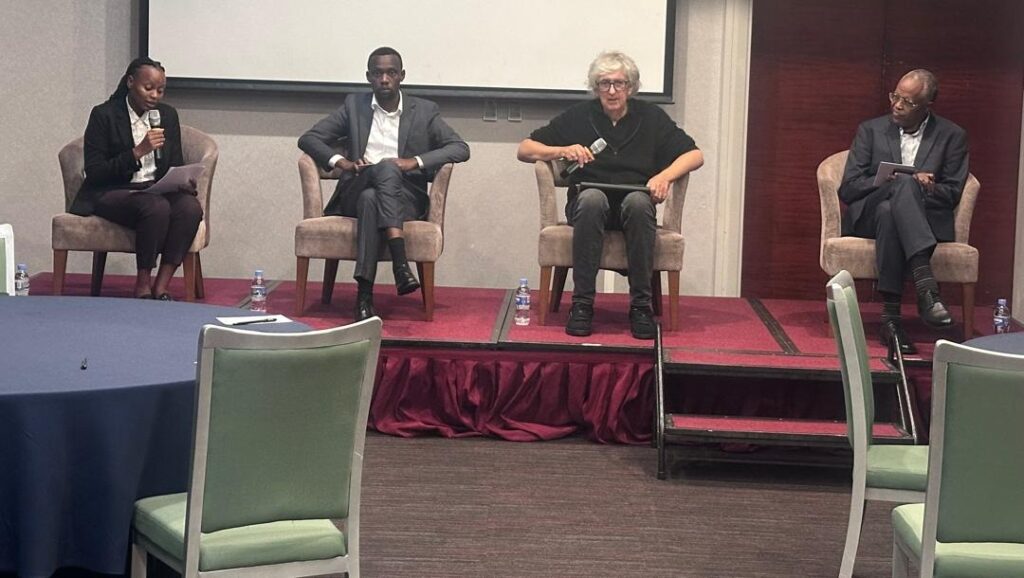
The presentations were followed by a panel discussion featuring experts in climate advisory services, climate-smart agriculture, climate information systems, and climate finance. Panelists reflected on the model's relevance to planning, its economic value, and how it could be better integrated into decision-making systems. They also stressed the importance of thoughtful scenario design and raised nuanced questions about what CSA interventions truly entail, noting that the climate-smartness of any intervention depends on its appropriateness to the local context and how it is applied. On the financing side, panelists observed that while there have been numerous global commitments to fund green projects, these conversations have too often sidelined the central role of rural livelihoods. A notable suggestion was on leveraging RIAPA to generate the kind of evidence that can attract private sector investment.
The workshop closed with an open exchange among participants on how to improve the model and its communication, and on how its findings can be made more accessible and actionable for both public and private sector stakeholders. Plans are being developed to improve the model and further IFPRI’s mission to provide accurate and relevant evidence-based research for improved decision making. As an outcome of the workshop, a more climate-oriented model will be developed and publicly provided by the end of 2026.
Authors
Josue Niyonsingiza- Senior Research Analyst, Development Strategies and Governance, IFPRI, Rwanda Strategy Support Program.
Dr. James Warner, Research Fellow and Program Leader for IFPRI’s Rwanda Strategy Support Program, Development Strategies and Governance.
Leave a Reply